The Middle East is undergoing one of the fastest industrial digitalization programs in the world. Saudi Vision 2030, the UAE's National Agenda, and Qatar's National Development Strategy are all converging on a single enabler: real-time data from connected machines.
Industrial IoT is no longer a pilot-phase technology here - it's active infrastructure. Operators in Riyadh are remotely managing thousands of telecom tower sites. Logistics companies in Dubai are tracking refrigerated cargo via satellite. Energy firms in Doha are moving from manual field inspections to AI-driven predictive maintenance.
This guide breaks down the ten IIoT use cases that matter most in the region right now - with the specific problems they solve, the industries driving demand, and how Elint Systems is enabling them across 23+ countries including Saudi Arabia, Kuwait, and Qatar.
5 Solutions Reshaping GCC Industry
Telecom Tower Monitoring & Site Management
Operators like STC, Mobily, and Zain manage tens of thousands of remote tower sites across vast desert terrain - often with no reliable road access for weeks. Telecom tower monitoring in Saudi Arabia and Qatar has become a boardroom priority, not just an engineering one. The real pain isn't coverage gaps; it's knowing when a generator is about to fail or a fuel tank is running dry before a site goes dark.
Modern NOC teams need live visibility into power status, battery health, DG runtime, and door access events across every site - reducing emergency callouts and keeping SLA compliance intact. For operators running large tower portfolios in Qatar or across KSA's eastern provinces, this kind of remote site management is the difference between proactive operations and expensive reactive fixes.
Fuel Level Monitoring for Energy & Logistics
Fuel theft and inaccurate stock reporting cost Gulf logistics and energy companies millions every year. For companies managing distributed fuel storage across KSA's eastern oilfields or Kuwait's industrial zones, manual dipping simply doesn't scale. What operations teams need is a single dashboard showing every tank level in real time - with an alert the moment something looks off.
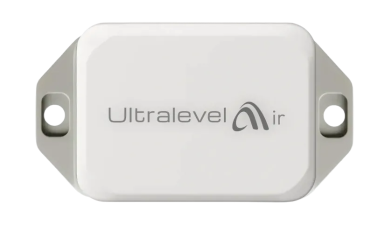
Fuel level monitoring in qatar has accelerated sharply as Aramco suppliers and independent logistics operators digitize their tank farms. Radar-based wireless level sensor deliver precise, tamper-evident readings with consumption trend analysis and automated delivery triggers - cutting both theft losses and emergency replenishment costs.
Diesel Generator Remote Monitoring
From NEOM construction camps to hospital backup power in Riyadh, diesel generators underpin critical infrastructure across the GCC. Yet the majority are still inspected manually - meaning a coolant leak or overload event only surfaces after the damage is done. Diesel generator monitoring in UAE and Saudi Arabia is now moving from a nice-to-have to an operational mandate, particularly for operators responsible for hundreds of distributed sites.
Remote DG monitoring tracks engine temperature, oil pressure, run hours, and load in real time, flagging anomalies well before they become failures. It transforms reactive, expensive site visits into scheduled, data-driven maintenance runs.
Oil & Gas Digital Oilfield Telemetry
Digital oil field monitoring in Saudi Arabia and Qatar isn't an emerging trend - it's already standard practice among tier-one operators. Saudi Aramco and Qatar Energy have both invested heavily in remote sensing infrastructure, and their suppliers are under growing pressure to match that visibility. A single undetected pipeline leak or wellhead pressure anomaly can cost millions in losses and regulatory penalties, and manual inspection across hundreds of square kilometers simply isn't viable.
The challenge for most operators isn't the sensors - it's connectivity. Cellular coverage across KSA's Rub' al Khali or Qatar's offshore zones is patchy at best. Industrial IoT platforms that combine satellite with LTE solve this without compromise.
Smart Water Management & Hydrology
Smart water management in Saudi Arabia is a national priority - the Kingdom loses an estimated 30 - 35% of distributed water to leaks and inefficiency in aging networks. For UAE municipalities managing desalination storage and irrigation across Abu Dhabi and Sharjah, the pressure to cut non-revenue water losses is just as acute. Real-time wireless tank level monitoring and automated pump controller are now central to every GCC water utility's digital roadmap.
IoT-based hydrology solutions give utility engineers instant visibility into reservoir levels, groundwater pressure, and pump performance - replacing manual site checks with automated alerts and remote control.
What separates effective IIoT deployment in the GCC
Three things consistently determine whether an IIoT project succeeds or stalls in the Middle East: hardware that can handle extreme conditions, connectivity that works beyond cellular coverage, and software that local operations teams will actually use.
Elint Systems addresses all three - with ATEX-certified sensors rated for 60°C+ environments, a multi-network portfolio spanning LoRaWAN, NB-IoT, 4G, and Satellite, and an Elint Cloud platform already proven across utilities, telecoms, and energy in Saudi Arabia, Kuwait, and Qatar.
If you're evaluating IIoT platforms for a GCC deployment, the starting point is always a site-specific conversation - not a generic product demo. Talk to the Elint team about your specific use case, site conditions, and connectivity requirements.
Frequently Asked Questions
What is Industrial IoT and why is it important in the GCC?↓
Which industries in the Middle East are adopting IIoT the fastest?↓
How does telecom tower monitoring work in Saudi Arabia?↓
What is the biggest challenge for IIoT deployment in the GCC?↓
How does fuel level monitoring reduce theft in Gulf logistics operations?↓